

 Türkçe
 English
KVKK COMPLİANCE FİLE EXİSTS — BUT THE RİSK IS NOT OVER: 2026 PERSPECTİVE
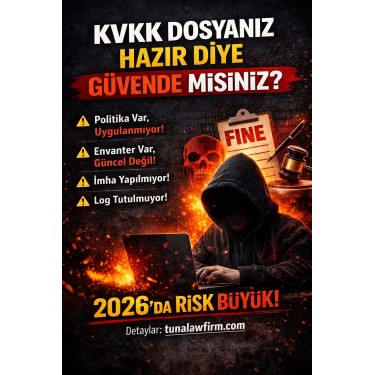
Many companies assume that KVKK compliance is completed once policy documents are prepared, VERBIS registration is finalized, and a few procedures are written.
However, what Board decisions and field audits in 2025–2026 clearly demonstrate is this:
There is a significant gap between the existence of documentation and actual, effective compliance.
The most common picture we encounter in practice is as follows:
• Policy exists → not implemented
• Data inventory exists → not up to date
• Explicit consent exists → legal basis is flawed
• Retention and destruction policy exists → destruction is not actually performed
• Technical measures documented → logs are not maintained
For this reason, many organizations operate—often unknowingly—in a position that is “formally compliant on paper, but risky in practice.”
Critical Risk Areas the Authority Focuses on in 2026
Considering recent trends, audits particularly highlight the following areas:
Outdated Data Inventories
Companies often prepare the inventory once and then shelve it. However, every new process changes personal data processing activities.
Incorrect Structuring of Explicit Consent vs. Privacy Notice
In many organizations, privacy notices and explicit consent texts are still used interchangeably. This continues to be cited as a clear violation ground in Board decisions.
Retention and Destruction Processes Not Functioning in Practice
Even where policies exist, automatic deletion, periodic destruction, and logging mechanisms do not operate effectively in many organizations.
Data Transfers Within Supplier and Group Company Structures
Data sharing within holding and group structures remains one of the highest-risk areas.
New Era for Companies: From “Document Compliance” to “System Compliance”
KVKK compliance is no longer merely a legal documentation exercise.
In our approach, sustainable compliance is only possible when the following three layers operate together:
• Legal layer (policies and legal texts)
• Operational layer (process integration)
• Technical layer (measurable controls and logging)
Unless this three-pillar structure is properly established, companies will continue to carry audit exposure risks.
Quick Self-Assessment: Is Your Company Truly Safe?
If you cannot clearly answer “yes” to the following four questions, your risk exposure may still be ongoing:
• Has your data inventory been updated within the last 6 months?
• Does your automated deletion mechanism generate verifiable logs?
• Are your intra-group data transfers contractually safeguarded?
• Does every instance where you obtain explicit consent truly require consent?
Conclusion
As of 2026, KVKK compliance is not a static set of documents;
it must function as a living, measurable, and auditable management system.
The real risk for companies today is no longer “doing nothing,” but rather
continuing to carry risk while assuming they are compliant.
Av. Dr. Çağrı TUNA
KVKK & GDPR Consultant